Use case
A backend for web games
Portals bring the players; they do not keep the inventory, the wallet or the season. Rudder is the modular backend behind the portal: ready modules for the meta, and the missing ones written by your engineer or an agent.
What the portal gives you, and what it does not
A web game on CrazyGames, Poki or Yandex Games lives inside someone else's shell: their traffic, their ads, their sign-in button. Portals hand you distribution, an SDK and usually a player identity — but they do not hold a player's inventory, and they do not care that a reward was granted twice. When a game runs on three portals, three identities and three save files are the first problem, and a store window that opens in one build and not the next is the second.
Sign-in that works inside the portal
- CrazyGames — the token exists only inside crazygames.com; the platform checks it against your game id. A token of another game is refused.
- Yandex Games — the signature is recomputed with your game secret, so a forged answer does not get through.
- Yandex ID, Google, Apple, Facebook, VK ID — for a game that also lives outside the portal.
- Any OIDC provider, or a webhook of your own where no provider covers the case.
Poki has no dedicated provider here yet: those players sign in with your own accounts through OIDC or the webhook. The CrazyGames and Yandex Games pages list exactly what each one needs.
Saves and the economy move with the player
- Inventory — stacks with a limit and unique pieces with attributes.
- Wallets — currencies with promotions and a ledger, so a support question has an answer.
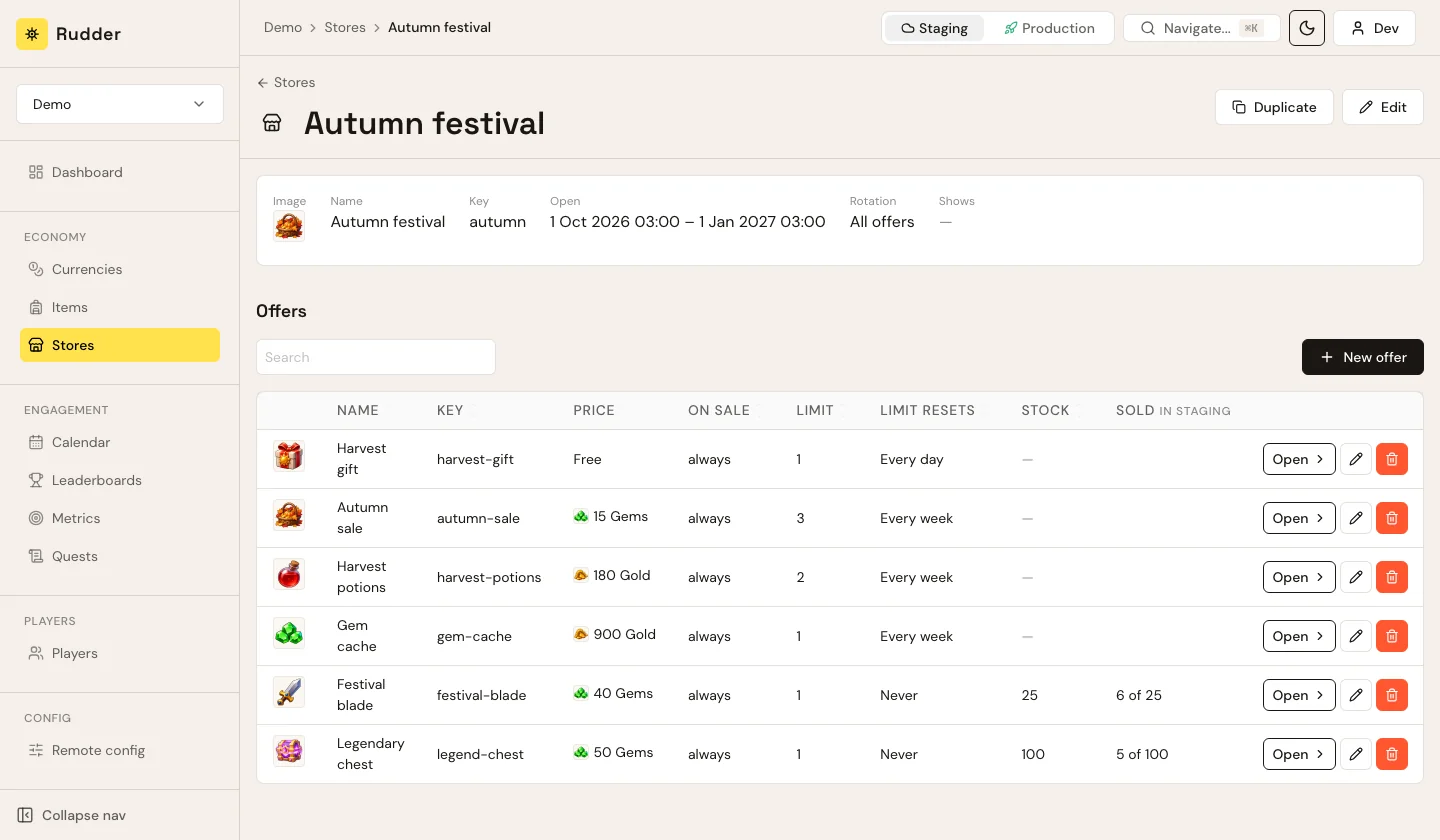
- Stores — offers with a price, a sale window, a limit per player and period, a stock all players share, and rotations.
- One purchase, once — a request key is recorded, so a retry after a timeout returns the recorded result instead of charging twice.
Seasons without a new build
Web builds are cached hard: a player can sit on last month's bundle for weeks. Remote config and the LiveOps calendar let a designer open a weekend sale or start a quest line, publish it with a release, and roll back if it breaks — while the old build in the browser reads the new values. The remote config and stores pages show the shape of both.
Your own mechanic, written with an agent
The part that makes your game yours — a pet expedition, a merge board, a boss rotation — is a module: your engineer writes it with a coding agent, publishes it from the CLI, and gets admin pages and a generated TypeScript client for the browser build. The own modules page walks through it.
What is not in the box
- No real-money offers and no receipt validation: a portal payment is your flow, and the store here handles what the purchase grants.
- No ads, no Poki-specific provider, no multiplayer servers, matchmaking or voice.
- One region, email support, no contractual SLA.
- Early access: no external studio runs on Rudder yet, and the demo game is ours.
- Pricing after early access is not settled.
The shortest test is one module on one portal: a store with two offers, a quest line, or a leaderboard. Read the quickstart, or see how Rudder compares to PlayFab.
Try it with one mechanic
Early access is free. We help you connect one module to your game, then you decide whether the rest of the meta belongs on Rudder.